
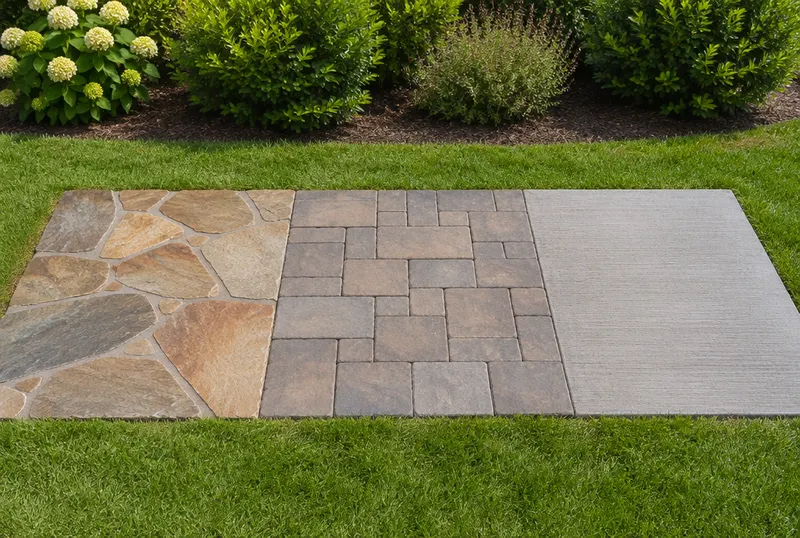
Choosing between flagstone, pavers and concrete is the biggest decision in most patio projects, and no single material wins everywhere. This comparison explains how each one looks, behaves and ages so you can match the surface to your yard and the way you use it.
Natural flagstone
Flagstone is cut from layered natural stone, so every piece differs in color, thickness and texture. That variation gives patios an organic, one-of-a-kind look that suits informal gardens and rustic or Mediterranean architecture. Stone also holds up well to sun and weather, and its surface tends to be comfortable underfoot.
The tradeoffs are cost of material and labor, and the skill involved. Irregular pieces must be fitted carefully, and a mortared installation needs a solid base while a dry-laid installation needs well-compacted aggregate and tight joints. Flagstone can also be slightly uneven, which affects furniture with narrow legs. Our patios and outdoor living spaces work often uses natural stone for exactly these reasons.
Concrete pavers
Pavers are manufactured units in consistent shapes, colors and thicknesses, available in many textures and patterns. Their uniformity makes layouts precise and gives clean lines that suit contemporary and traditional homes alike. Because each unit is set over a compacted base, repairs are straightforward: individual pavers can be lifted and reset if settling or tree roots disturb them.
Pavers do rely on good edge restraint and base preparation. Without those, they can shift or sink over time, which is why the work below the surface matters more than the surface itself. They also suit driveways and walkways, which we cover under pavers, walkways and driveways.
Poured concrete
Concrete is the most versatile surface: it can be broomed, stamped, colored, exposed or saw-cut into patterns, and it covers large areas efficiently. A clean, continuous slab suits modern designs, and concrete works well as a secondary surface for paths, steps and borders that frame another material.
Its limits are cracking and repair. Concrete is rigid, so control joints are planned to guide where it cracks, and a crack cannot be replaced one piece at a time the way a paver can. Color and finish should be specified carefully, since plain gray in full sun can feel hot and bright. See how this fits into broader projects in our concrete flatwork overview.
How to choose by use and site
Start with how the space will be used. Heavy furniture, wheeled grills and frequent entertaining favor flat, consistent surfaces such as pavers or well-set stone. A garden path through planting may suit irregular stone. Slopes, drainage and soil movement also matter: surfaces that can be repaired in sections often do better where ground shifts.
Consider climate and comfort. In hot inland areas such as Atascadero, lighter colors and textured finishes stay cooler barefoot than dark, smooth ones. Think about the home as well: a surface should look as if it belongs to the architecture rather than competing with it.
- Formal, precise layouts: pavers or cut stone
- Natural, informal gardens: flagstone
- Large areas or modern design: concrete
- Ground that moves: surfaces that can be reset in sections
The base matters more than the surface
Every patio material depends on what is under it. Proper excavation, compacted aggregate base and drainage that moves water away from the house determine whether a patio stays flat for years. Skipping base work to save time is the most common reason patios fail, and no surface can compensate for it.
Water management is part of the base. Slope the surface gently away from structures, plan for runoff, and avoid trapping moisture next to foundations or tree roots.
Maintenance and mixing materials
Maintenance differs. Stone and pavers may need joint refills and occasional sealing or cleaning, while concrete may need periodic sealing and attention to cracks. All benefit from sweeping, prompt stain treatment and keeping drains clear.
You do not have to pick only one. Many of the best patios mix materials, for instance pavers for the main terrace with stone accents or concrete borders. For ideas on combining them, read our guide to outdoor living space design, or contact us to talk through your site.
Frequently asked questions
Which patio material lasts the longest?
All three can last many years when installed over a properly prepared base. Longevity depends more on excavation, compaction, drainage and edge restraint than on the surface itself. Natural stone and pavers can be repaired in sections, while concrete tends to be more continuous and may show cracks over time.
What is the most comfortable patio surface in hot weather?
Lighter colors and textured finishes generally stay cooler than dark, smooth ones, regardless of material. Natural stone and certain light pavers are often comfortable, while dark or glossy surfaces in full sun can get hot. Shade and planting around the patio make a bigger difference than the material alone.
Can I combine flagstone, pavers and concrete?
Yes. Combining materials adds interest and can improve function, such as concrete for paths and pavers or stone for the main seating area. The key is keeping the palette limited, usually two or three materials, and making sure the transitions are level and well drained.
Do patios need drainage?
Yes. Water should move away from the house, seating areas and tree roots. That is handled through grading, a slight slope in the surface and, where needed, drains. It is planned before installation, because correcting drainage afterward usually means lifting the surface.