
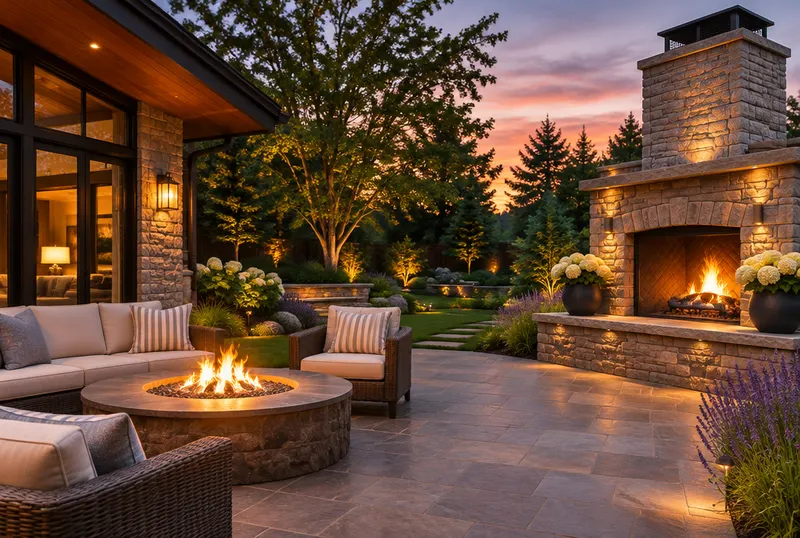
Choosing between a fire pit and an outdoor fireplace comes down to how you gather, where you live and how much of the yard you want the fire to anchor. This comparison covers the practical differences so you can pick the right fire feature for your property.
The basic difference
A fire pit is typically a low, open fire that people sit around. It is social and flexible, works in the middle of a patio and gives warmth in every direction. An outdoor fireplace is a vertical masonry structure with a firebox and chimney, usually built at the edge of a space, which draws smoke up and directs heat outward toward seating.
Neither is better in every case. The right choice depends on wind, space, how you want to sit, and the look you want from the rest of the landscape.
Layout and seating
A fire pit invites a circle of seating and conversation where everyone faces each other. It needs clear space on all sides, generally more than people expect, so plan the surrounding patio accordingly. A fireplace works like a focal wall. Seating faces it, and it can also help define the edge of an outdoor room or screen a view.
If you are designing a larger patio and outdoor living space, ask which element should be the center of gravity. Sometimes the answer is a pit in an open courtyard, and sometimes it is a fireplace anchoring a covered seating area.
Wind, smoke and Central Coast conditions
Afternoon winds are common in many parts of the Central Coast and inland valleys, and wind changes how a fire behaves. A pit in an exposed spot can throw smoke and embers toward guests. A fireplace with a chimney is more forgiving because the flue carries smoke upward and the masonry shelters the flame.
Evenings can cool quickly, even after hot days, so the fire is often used more than people expect. Orienting seating so smoke drifts away from it and from the house makes a real difference.
Fuel: wood or gas
Wood fires offer crackle and aroma but produce smoke, ash and embers, and they may be restricted during dry periods or by local air and fire rules. Gas fires start easily, burn cleanly and can be switched off quickly, but they depend on a gas line and a controlled burner.
We build the masonry and surrounds. Gas lines and appliance hookups, and any line-voltage electrical for igniters, are coordinated with licensed specialists, and permits may be required. If you want gas, decide early so the base and trenching can be planned together.
Always check local burn rules and fire-season restrictions before using a wood-burning feature.
Safety, clearances and fire-prone sites
Keep fire features away from overhanging branches, dry grass, fences and structures, and use noncombustible surfaces beneath and around them. Maintain defensible space and remove dry vegetation nearby. Spark control, such as a screen or a properly designed chimney cap on a fireplace, helps contain embers.
Setbacks, height and fuel type can be regulated by your city, county or HOA. Our overview of HOA and permits for landscape projects explains what to check before you commit to a design.
Materials, space and combining features
Both options can be built in natural stone, cut stone veneer, stucco or concrete, so they can match your walls and patio. Look at the patio materials comparison when coordinating finishes. Allow room for seating, walkways and storage for wood if you burn it.
Many yards use both: a fireplace near the house for cooler nights, and a pit farther out for casual gatherings. A fire feature also pairs naturally with an outdoor kitchen, and with water features for sound.
Frequently asked questions
Which is safer, a fire pit or a fireplace?
Either can be safe when well designed and used properly. A fireplace's chimney directs smoke and sparks upward, while a pit needs generous clearance and good placement. Surfaces, setbacks, wind and fuel type all matter more than the category.
Is gas or wood better for a fire feature?
It depends on your priorities. Wood gives traditional crackle and scent but creates smoke, ash and possible seasonal restrictions. Gas is convenient and cleaner, but requires a gas line and appliance connection coordinated with licensed specialists.
Can I add a fire pit to an existing patio?
Often yes, if the surface is noncombustible and there is enough clearance around it. A gas pit needs a gas line to reach the spot. A site visit helps confirm the base, drainage and placement.
Do I need a permit?
Possibly. Requirements vary by city, county, coastal zone and HOA, and gas, electrical or a masonry chimney can add review. Check with your jurisdiction early, and we can help prepare documentation and coordinate.